


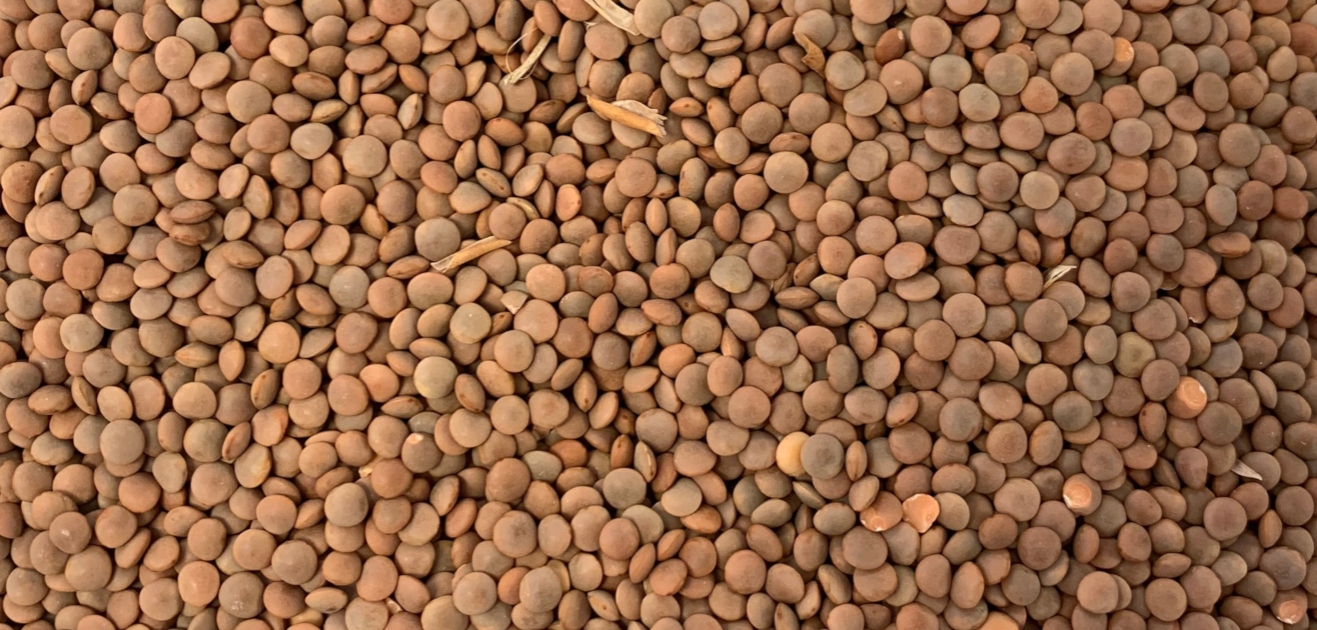
Grain Snippet: Lentil Exports Surge Amid Large Supply
With the Aussie lentil harvest now mostly completed, the peak seasonal selling pressure has started to ease. Bids have subsequently improved from delivered values circa $615/MT at major ports to indications between $630-$650/MT at the time of writing. Part of the lift is also driven by shipping shorts, with ongoing exports commitments now seeing some modest strain caused by lower grower selling liquidity post-harvest.
The month of November saw a surge in Ausie lentil exports with India reportedly taking in 154kMT for the month and making up nearly 50% of all Aussie lentil exports. Exports to Bangladesh were also relatively large for the month at 54kMT. The large volume for the shipping season to-date for 25/26 (Oct-Nov) is over three times what was seen in the same period for 24/25. The huge increase is a consequence of larger supplies y/y.
In addition to an area increase to lentil of 9.6% y/y, late seasonal rainfall bolstered yields for many SA and Vic growers, leading to a significantly larger estimated crop size. ABARES’ December update pegged Australia’s lentil production near a record 1.9MMT, up 12% on their previous estimate and is 51% larger than the drought-impacted 24/25 season.
Australia’s exports are estimated to reach 1.1MMT; whilst this figure is below the records seen in 22/23 and 23/24 (at 1.7MMT and 1.5MMT respectively), it comes with the caveat that ending-stocks will likely be record large near 57%. For 25/26, Australia’s lentil exports are competing with large global supplies, which is roughly (27-30%) larger y/y amid the major players. Notably, Canada’s final lentil production was reported at a record 3.36MMT by Stats Can, with some estimates putting the crop even larger. Similar to Australia, Canada’s stocks-to-use is estimated to be record large at 63%.
Fundamentally, global demand for lentils in 25/26 remains outweighed by supply, particularly with the new production records set in each Australia and Canada in addition to increases in the Black Sea region. Meanwhile, India’s lentil appetite is likely to be lower overall compared to recent years as both domestic pulse production has improved, alongside significant imports in recent years (of both lentils and yellow peas) to bolster food security. India’s food price inflation is in a far better position compared to the last five years. India’s food and retail inflation decline has slowed in recent months, but thus far remains in-check.
Amid improved food-price stability, coupled with the Indian government’s efforts toward pulse self-sustainability and protection of domestic growers, there increased speculation of further import duty increases on lentils. This speculation was part of the drive for exporters to front-end their program in Australia once the tonnes started to flow. The capacity for the broader subcontinent market to absorb the large supply is limited, but will be strongly determined by the upcoming Rabi crop in India, their primary domestic pulse crop. To-date, India’s lentil planting progress is slightly above last year’s pace amid favourable conditions.
This is a sample only, if you would like to view the entire document and our recommendations, please contact CloudBreak to discuss becoming a member on (08) 8388 8084.